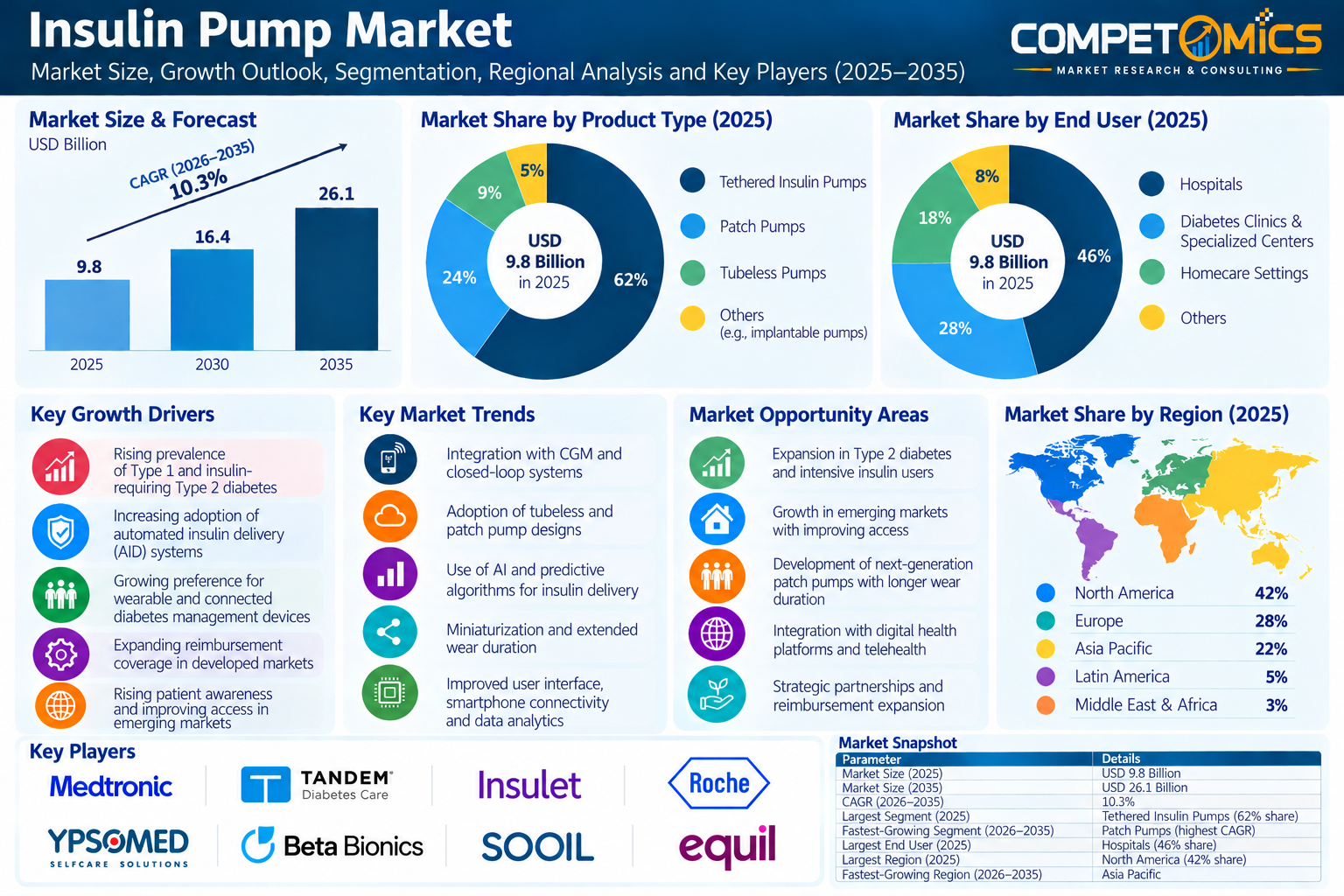
Insulin Pump Market was valued at USD 6.6 billion in 2025 and is projected to reach USD 21.5 billion by 2035, expanding at a CAGR of 12.7% during 2026-2035. Market expansion is supported by structural demand, technology adoption, increasing healthcare utilization and the need for more convenient, effective or connected solutions. Key opportunities include patch-pump adoption, CGM-pump interoperability, and type 2 diabetes expansion.
MARKET VISUALS
Market Overview & Sample Analysis
MARKET VISUALS
Market Overview & Sample Analysis
By Product Type
The market is led by established products that have the broadest installed base and reimbursement familiarity, while the fastest-growing segment is the technology category with the strongest connectivity, automation and recurring-use economics. In insulin pump market, conventional products remain important because they offer affordability, familiar workflows and extensive distribution. However, connected and advanced products are gaining share as patients and clinicians increasingly expect real-time data, automated alerts and easier integration with digital health platforms. Product design is also shifting toward smaller, simpler and more discreet devices. In mature markets, replacement demand is increasingly influenced by interoperability and software rather than hardware alone. In emerging markets, price and consumable availability remain more decisive. Manufacturers therefore face a dual requirement: protect the economics of the established installed base while introducing advanced systems that justify premium pricing. Over the forecast period, product leadership is likely to remain with companies that can combine reliable core hardware with recurring consumables, digital services and strong distribution.
By Technology
Connected and automated technology represents the fastest-growing area because it changes the role of a device from a measurement or delivery instrument into an active component of a digital care ecosystem. Bluetooth, smartphone integration, cloud data, AI analytics and interoperable device architectures are increasing the amount of usable information generated outside clinical settings. In advanced insulin delivery, algorithms can automate dosing decisions; in monitoring, continuous or frequent data can identify trends and alerts; in SMBG, connected meters can reduce data-entry burden. Conventional technology will continue to account for a substantial installed base because cost, reimbursement and clinical familiarity matter. The opportunity is therefore not an immediate replacement cycle but a gradual migration toward higher-value connected systems. Companies that can demonstrate accuracy, reliability, cybersecurity, ease of use and compatibility with other devices are better positioned to benefit from this transition.
By End User
Homecare is increasingly the largest and fastest-growing end-user environment because chronic diabetes management is shifting away from hospital-centric care toward self-management supported by remote monitoring. Patients can use meters, CGMs, pens and pumps without continuous institutional supervision, while clinicians can review remotely transmitted data. Hospitals and specialty clinics remain important for initiation, complex cases and education, but the recurring use of devices increasingly occurs in the home. This shift creates opportunities for telehealth, remote patient monitoring, digital coaching and subscription support. Adoption will vary by reimbursement and healthcare infrastructure. High-income markets can support premium connected systems, whereas emerging markets require lower-cost devices and dependable consumables. Over time, the winning end-user model will increasingly combine device simplicity with clinical connectivity, allowing providers to intervene selectively rather than requiring frequent in-person visits.
Region and Country Analysis
MARKET VISUALS
Market Overview & Sample Analysis
North America remains a major revenue center because of high healthcare expenditure, established reimbursement pathways, strong technology adoption and the presence of leading manufacturers. The United States generally drives regional commercialization through early product launches, advanced provider infrastructure and significant private and public healthcare spending. Canada contributes through universal healthcare coverage and technology adoption, although procurement and reimbursement structures differ from the U.S. Europe represents a mature but heterogeneous market. Germany, the United Kingdom, France and Italy combine established healthcare infrastructure with increasing emphasis on cost effectiveness, regulatory compliance and digital health. Market access is influenced by national reimbursement decisions, public procurement and EU-level regulatory requirements. Vendors increasingly compete through lifecycle service, clinical evidence, interoperability and total cost of ownership. Asia Pacific is the key expansion region as healthcare infrastructure improves, chronic disease burden rises, technology awareness increases and manufacturers broaden local distribution. China, Japan, India and South Korea represent important demand centers, but the adoption curve differs substantially by reimbursement, affordability, local manufacturing and clinical practice. Localization, lower-cost product architectures and partnerships with local healthcare providers can therefore create significant opportunities.
Competitive Landscape
The competitive landscape includes multinational manufacturers and specialized technology companies, with Medtronic, Tandem Diabetes Care and Insulet among the most prominent participants in the analyzed market. Their position reflects combinations of installed product base, geographic reach, portfolio breadth, technology investment, distribution capabilities and ecosystem relationships rather than a single competitive factor. Medtronic benefits from established scale and portfolio depth; Tandem Diabetes Care has a strong position in product innovation and market expansion; and Insulet adds complementary capabilities in technology, delivery, monitoring or distribution. Competitive intensity is increasingly shifting from individual products to integrated ecosystems, where software, connectivity, recurring consumables, reimbursement access and clinical support influence customer retention. Smaller specialists and emerging manufacturers can compete through focused technologies, lower-cost models or partnerships. Recent strategic activity among leading participants has centered on product launches, technology integration, interoperability, partnerships and geographic expansion. For this report, the competitive-development chapter will track developments involving Medtronic, Tandem Diabetes Care and Insulet, including qualifying mergers, acquisitions, partnerships, collaborations, product launches, geographic expansions and major product updates. These developments are important because they indicate how leading companies are building ecosystems, extending product lifecycles and entering adjacent segments. Overall, the market is moving toward higher-value, technology-enabled solutions while established products continue to provide a large recurring revenue base. Through 2035, growth is expected to be shaped by affordability, broader access, interoperability, automation and data-driven care. Companies that combine reliable products with digital platforms, evidence generation and efficient distribution will influence the next phase of market development.