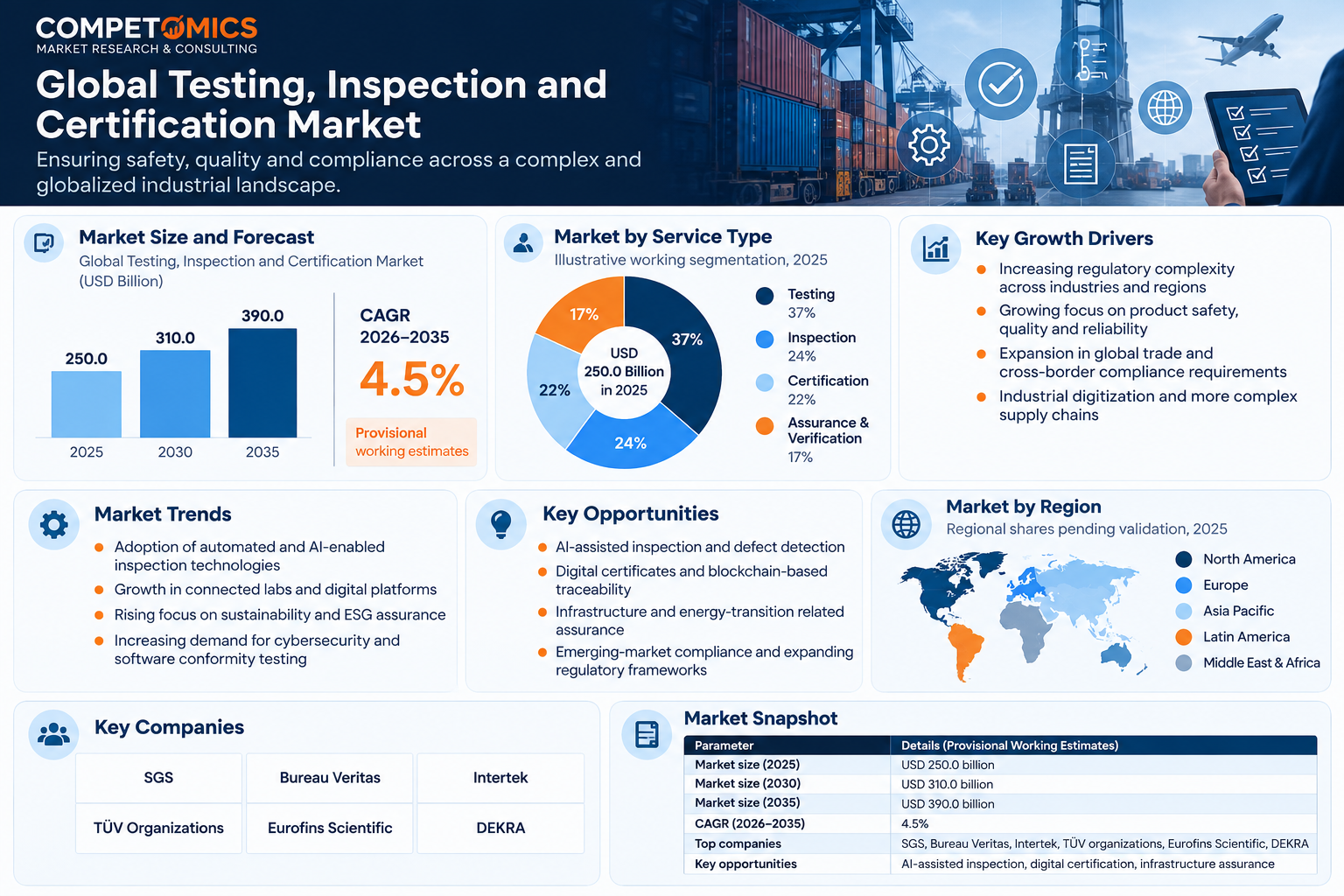
The global testing, inspection and certification market was provisionally estimated at USD 250.0 billion in 2025 and is projected to reach USD 390.0 billion by 2035, representing a CAGR of 4.5% during 2026-2035. Market development is supported by regulatory compliance across manufacturing and infrastructure, rising product-safety requirements, cross-border trade, sustainability verification, and the growing complexity of connected products. Growth will depend on investment cycles, customer economics, technology readiness, regulatory requirements and the ability of suppliers to demonstrate measurable value. The market is evolving from standalone products and point solutions toward connected, data-enabled and service-oriented offerings. Customers increasingly assess lifecycle cost, interoperability, reliability, security, energy performance and support coverage alongside purchase price. Suppliers that combine product performance with implementation expertise, analytics and recurring services may strengthen customer retention; however, adoption can be constrained by capital budgets, integration complexity, skills shortages and inconsistent standards.
Market Snapshot
MARKET VISUALS
Market Overview & Sample Analysis
Technology and Market Trend Pointers
By Service Type
MARKET VISUALS
Market Overview & Sample Analysis
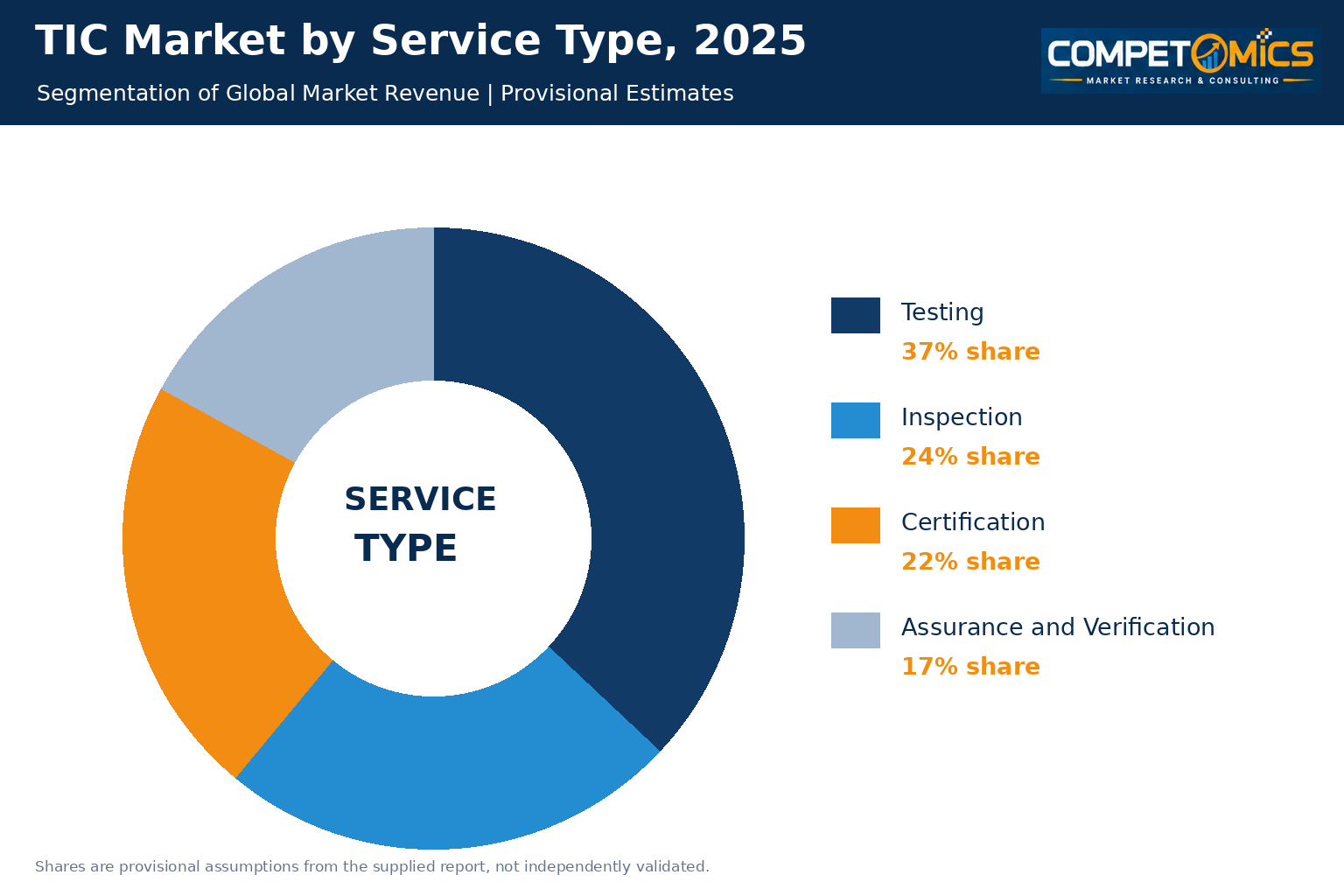
Testing services accounted for approximately 37% of the segment's 2025 revenue and is provisionally forecast to expand at a 6.8% CAGR from 2025 to 2035. Its position reflects its established role across core global testing, inspection and certification market purchasing and deployment decisions, supported by broad applicability, installed-base demand and familiar procurement pathways.
Inspection services represented an estimated 24% share in 2025 and is provisionally forecast to expand at a 5.7% CAGR from 2025 to 2035. Demand is supported by customers seeking improved performance, operating efficiency and dependable integration with existing systems; adoption varies with project budgets and technical requirements.
Certification services contributed an estimated 22% of segment revenue in 2025 and is provisionally forecast to expand at a 7.2% CAGR from 2025 to 2035. This subsegment serves more specialized requirements where reliability, compliance, throughput or lifecycle economics can outweigh initial purchase price.
Assurance and verification services accounted for an estimated 17% of segment revenue in 2025 and is provisionally forecast to expand at a 8.1% CAGR from 2025 to 2035. Although smaller today, this area can gain relevance as product capabilities improve and buyers address emerging requirements, retrofit needs and use cases not fully served by conventional solutions.
By Sourcing Type
Outsourced TIC services accounted for approximately 38% of the segment's 2025 revenue and is provisionally forecast to expand at a 8.2% CAGR from 2025 to 2035. Its position reflects its established role across core global testing, inspection and certification market purchasing and deployment decisions, supported by broad applicability, installed-base demand and familiar procurement pathways.
In-house testing and inspection represented an estimated 29% share in 2025 and is provisionally forecast to expand at a 7.4% CAGR from 2025 to 2035. Demand is supported by customers seeking improved performance, operating efficiency and dependable integration with existing systems; adoption varies with project budgets and technical requirements. Managed and embedded TIC programs contributed an estimated 21% of segment revenue in 2025 and is provisionally forecast to expand at a 9.1% CAGR from 2025 to 2035. This subsegment serves more specialized requirements where reliability, compliance, throughput or lifecycle economics can outweigh initial purchase price.
Digital and remote TIC services accounted for an estimated 12% of segment revenue in 2025 and is provisionally forecast to expand at a 10.3% CAGR from 2025 to 2035. Although smaller today, this area can gain relevance as product capabilities improve and buyers address emerging requirements, retrofit needs and use cases not fully served by conventional solutions.
By End-use Industry
Consumer and retail products accounted for approximately 36% of the segment's 2025 revenue and is provisionally forecast to expand at a 4.6% CAGR from 2025 to 2035. Its position reflects its established role across core global testing, inspection and certification market purchasing and deployment decisions, supported by broad applicability, installed-base demand and familiar procurement pathways.
Industrial and manufacturing represented an estimated 26% share in 2025 and is provisionally forecast to expand at a 5.8% CAGR from 2025 to 2035. Demand is supported by customers seeking improved performance, operating efficiency and dependable integration with existing systems; adoption varies with project budgets and technical requirements. Construction and infrastructure contributed an estimated 22% of segment revenue in 2025 and is provisionally forecast to expand at a 6.7% CAGR from 2025 to 2035. This subsegment serves more specialized requirements where reliability, compliance, throughput or lifecycle economics can outweigh initial purchase price. Food, agriculture and life sciences accounted for an estimated 16% of segment revenue in 2025 and is provisionally forecast to expand at a 7.5% CAGR from 2025 to 2035. Although smaller today, this area can gain relevance as product capabilities improve and buyers address emerging requirements, retrofit needs and use cases not fully served by conventional solutions.
By Application
Product quality and safety accounted for approximately 29% of the segment's 2025 revenue and is provisionally forecast to expand at a 4.6% CAGR from 2025 to 2035. Its position reflects its established role across core global testing, inspection and certification market purchasing and deployment decisions, supported by broad applicability, installed-base demand and familiar procurement pathways.
Regulatory compliance and certification represented an estimated 27% share in 2025 and is provisionally forecast to expand at a 5.8% CAGR from 2025 to 2035. Demand is supported by customers seeking improved performance, operating efficiency and dependable integration with existing systems; adoption varies with project budgets and technical requirements.
Environmental and sustainability assurance contributed an estimated 25% of segment revenue in 2025 and is provisionally forecast to expand at a 6.7% CAGR from 2025 to 2035. This subsegment serves more specialized requirements where reliability, compliance, throughput or lifecycle economics can outweigh initial purchase price.
Supply-chain and asset integrity accounted for an estimated 19% of segment revenue in 2025 and is provisionally forecast to expand at a 7.5% CAGR from 2025 to 2035. Although smaller today, this area can gain relevance as product capabilities improve and buyers address emerging requirements, retrofit needs and use cases not fully served by conventional solutions.
MARKET VISUALS
Market Overview & Sample Analysis
Regional / Geographic Analysis
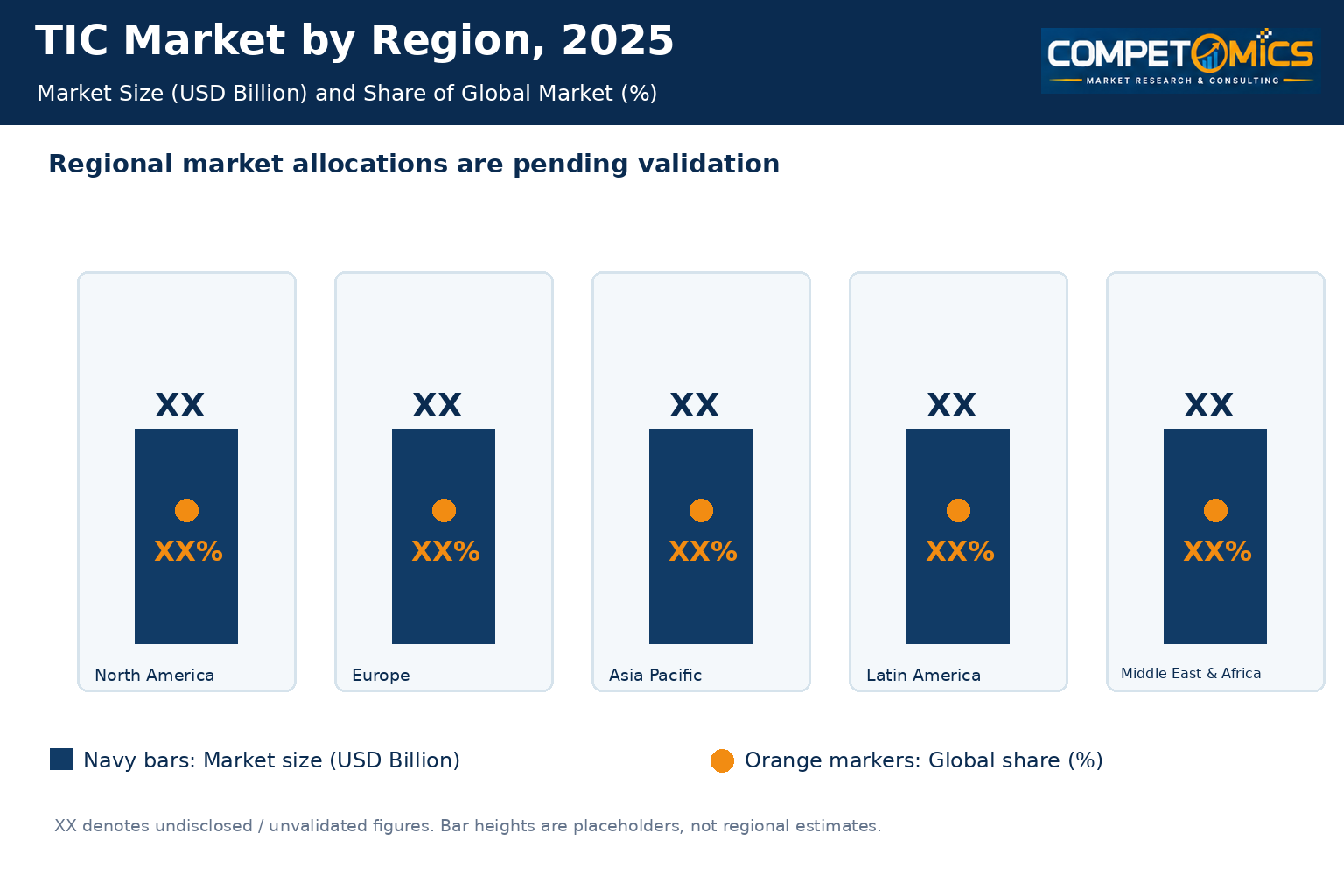
North America benefits from mature standards, large industrial and technology sectors, and demand for cybersecurity, environmental and product-compliance testing. Europe is shaped by harmonized standards, product-safety rules and sustainability requirements. Asia Pacific benefits from manufacturing scale, export activity and infrastructure investment, with China, Japan, India and South Korea providing distinct demand pools. Latin America is influenced by industrial modernization, food and agriculture testing, and trade compliance. The Middle East & Africa offers opportunities in construction, energy, infrastructure, food safety and public-sector quality programs. Across regions, demand is affected by local regulation, infrastructure maturity, customer financing, labor costs, climate or operating conditions, supply-chain access and availability of qualified installers or service partners.
Competitive Landscape
The global testing, inspection and certification (TIC) market is characterized by strong competition among internationally established service providers, with SGS, Bureau Veritas and Intertek occupying prominent positions. Their competitive advantages are supported by extensive laboratory and inspection networks, multinational customer relationships, technical accreditation, sector-specific expertise and the ability to provide integrated testing, inspection, certification and assurance services across multiple jurisdictions.
SGS reported record sales of CHF 6.95 billion in 2025, supported by organic growth of 5.6%. Its competitive positioning is strengthened by its diversified service portfolio and international operating network. The acquisition of Applied Technical Services further reinforced its presence in the United States and expanded its technical testing capabilities. Bureau Veritas generated revenue of EUR 6.47 billion in 2025, representing organic growth of 6.5%. Its LEAP | 28 strategy emphasizes portfolio development, operational performance and higher-growth service categories, reinforcing its position in industrial, infrastructure and compliance-related markets.
Intertek reported revenue of GBP 3.43 billion in 2025 and an adjusted operating margin of 18.1%. The company differentiates itself through its integrated Assurance, Testing, Inspection and Certification offering, particularly in product quality, supply-chain assurance and regulatory compliance. Together, these three companies form a leading competitive group, although their reported consolidated revenues should not be interpreted directly as market shares because service portfolios and reporting boundaries differ.
A notable competitive development occurred in January 2025, when SGS and Bureau Veritas ended discussions regarding a potential business combination without reaching an agreement. The proposed transaction highlighted the strategic importance of scale and consolidation within the TIC industry. Competition is also influenced by specialist providers such as Eurofins Scientific and DEKRA, whose technical expertise and sector-specific capabilities create competitive pressure in laboratory testing, automotive inspection and other specialized assurance services.
Market Outlook Through 2035, the global testing, inspection and certification market is expected to be shaped by the balance between structural demand and budget, policy and execution constraints. The strongest opportunities are likely to emerge where suppliers can demonstrate measurable improvements in productivity, reliability, safety, energy use or customer experience.