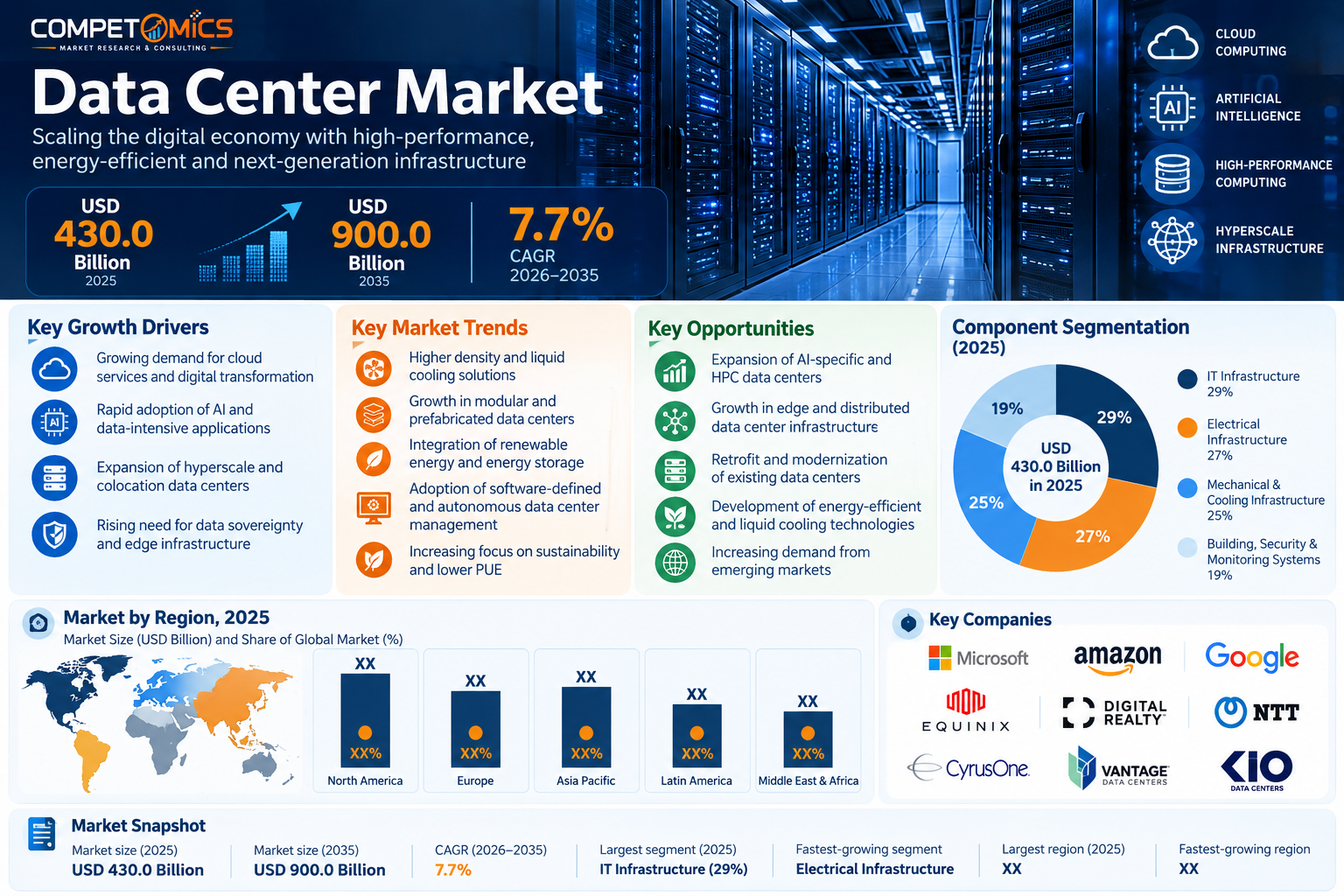
The data center market was provisionally estimated at USD 430.3 billion in 2025 and is projected to reach USD 900.1 billion by 2035, representing a CAGR of 7.7% during 2026-2035. Market development is supported by cloud migration, AI and high-performance computing workloads, digital services, enterprise modernization, data sovereignty requirements and demand for resilient low-latency infrastructure. Growth will depend on investment cycles, customer economics, technology readiness, regulatory requirements and the ability of suppliers to demonstrate measurable value.
The market is evolving from standalone products and point solutions toward connected, data-enabled and service-oriented offerings. Customers increasingly assess lifecycle cost, interoperability, reliability, security, energy performance and support coverage alongside purchase price. Suppliers that combine product performance with implementation expertise, analytics and recurring services may strengthen customer retention; however, adoption can be constrained by capital budgets, integration complexity, skills shortages and inconsistent standards.
Market Snapshot
MARKET VISUALS
Market Overview & Sample Analysis
Technology and Market Trend Pointers
MARKET VISUALS
Market Overview & Sample Analysis
By Component
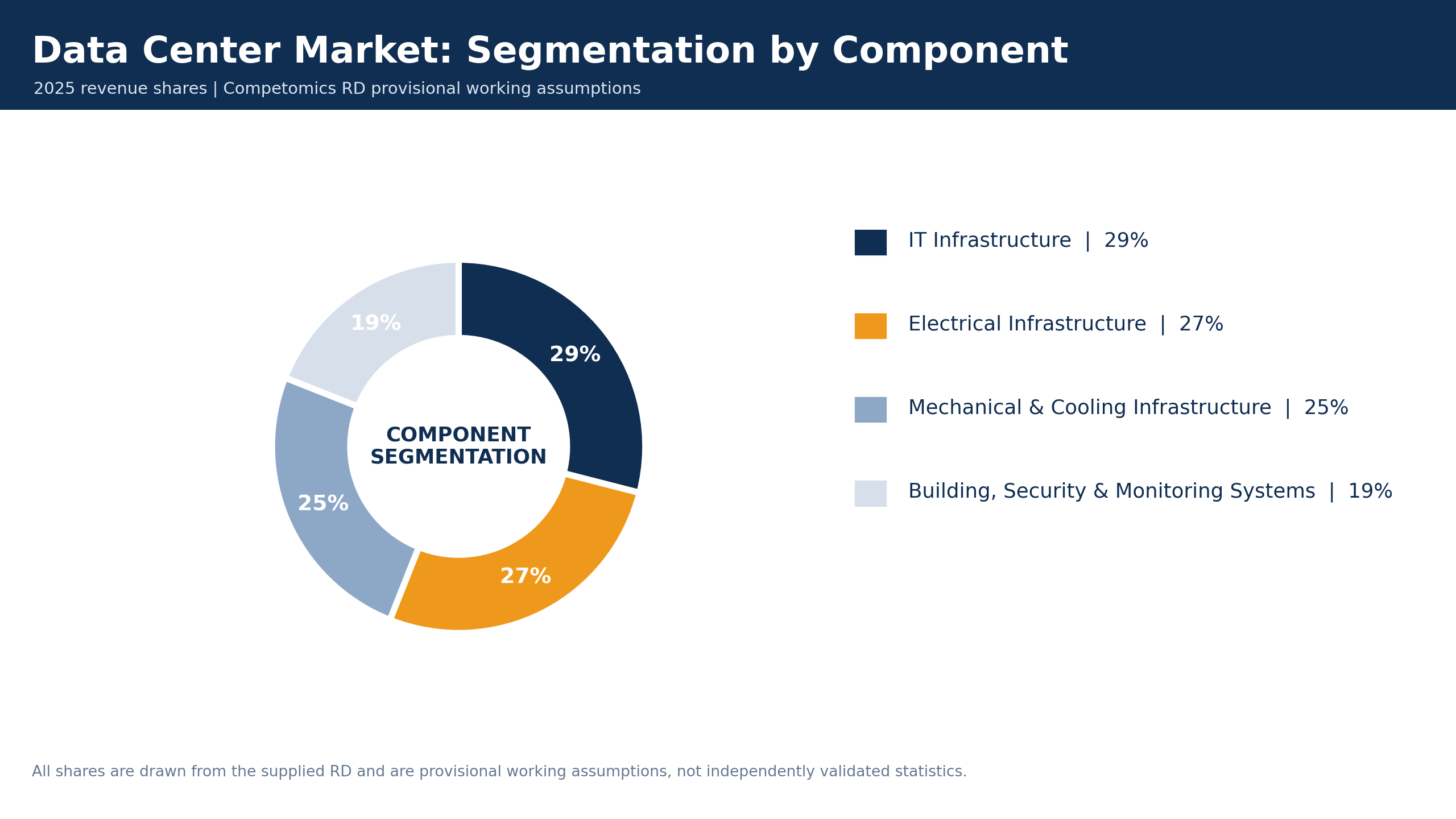
IT infrastructure accounted for approximately 29% of the segment's 2025 revenue and is provisionally forecast to expand at a 4.6% CAGR from 2025 to 2035. Its position reflects its established role across core data center market purchasing and deployment decisions, supported by broad applicability, installed-base demand and familiar procurement pathways.
Electrical infrastructure represented an estimated 27% share in 2025 and is provisionally forecast to expand at a 5.8% CAGR from 2025 to 2035. Demand is supported by customers seeking improved performance, operating efficiency and dependable integration with existing systems; adoption varies with project budgets and technical requirements.
Mechanical and cooling infrastructure contributed an estimated 25% of segment revenue in 2025 and is provisionally forecast to expand at a 6.7% CAGR from 2025 to 2035. This subsegment serves more specialized requirements where reliability, compliance, throughput or lifecycle economics can outweigh initial purchase price.
Building, security and monitoring systems accounted for an estimated 19% of segment revenue in 2025 and is provisionally forecast to expand at a 7.5% CAGR from 2025 to 2035. Although smaller today, this area can gain relevance as product capabilities improve and buyers address emerging requirements, retrofit needs and use cases not fully served by conventional solutions.
By Data Center Type
Hyperscale facilities accounted for approximately 33% of the segment's 2025 revenue and is provisionally forecast to expand at a 8.2% CAGR from 2025 to 2035. Its position reflects its established role across core data center market purchasing and deployment decisions, supported by broad applicability, installed-base demand and familiar procurement pathways.
Colocation facilities represented an estimated 30% share in 2025 and is provisionally forecast to expand at a 7.4% CAGR from 2025 to 2035. Demand is supported by customers seeking improved performance, operating efficiency and dependable integration with existing systems; adoption varies with project budgets and technical requirements.
Enterprise data centers contributed an estimated 22% of segment revenue in 2025 and is provisionally forecast to expand at a 9.1% CAGR from 2025 to 2035. This subsegment serves more specialized requirements where reliability, compliance, throughput or lifecycle economics can outweigh initial purchase price.
Edge and modular data centers accounted for an estimated 15% of segment revenue in 2025 and is provisionally forecast to expand at a 10.3% CAGR from 2025 to 2035. Although smaller today, this area can gain relevance as product capabilities improve and buyers address emerging requirements, retrofit needs and use cases not fully served by conventional solutions.
By Tier
Tier I and Tier II accounted for approximately 34% of the segment's 2025 revenue and is provisionally forecast to expand at a 4.6% CAGR from 2025 to 2035. Its position reflects its established role across core data center market purchasing and deployment decisions, supported by broad applicability, installed-base demand and familiar procurement pathways.
Tier III represented an estimated 28% share in 2025 and is provisionally forecast to expand at a 5.8% CAGR from 2025 to 2035. Demand is supported by customers seeking improved performance, operating efficiency and dependable integration with existing systems; adoption varies with project budgets and technical requirements.
Tier IV contributed an estimated 23% of segment revenue in 2025 and is provisionally forecast to expand at a 6.7% CAGR from 2025 to 2035. This subsegment serves more specialized requirements where reliability, compliance, throughput or lifecycle economics can outweigh initial purchase price.
Hybrid and concurrently maintainable designs accounted for an estimated 15% of segment revenue in 2025 and is provisionally forecast to expand at a 7.5% CAGR from 2025 to 2035. Although smaller today, this area can gain relevance as product capabilities improve and buyers address emerging requirements, retrofit needs and use cases not fully served by conventional solutions.
By End-user
Cloud and technology providers accounted for approximately 33% of the segment's 2025 revenue and is provisionally forecast to expand at a 5.4% CAGR from 2025 to 2035. Its position reflects its established role across core data center market purchasing and deployment decisions, supported by broad applicability, installed-base demand and familiar procurement pathways.
Telecommunications providers represented an estimated 30% share in 2025 and is provisionally forecast to expand at a 7.8% CAGR from 2025 to 2035. Demand is supported by customers seeking improved performance, operating efficiency and dependable integration with existing systems; adoption varies with project budgets and technical requirements.
BFSI and large enterprises contributed an estimated 22% of segment revenue in 2025 and is provisionally forecast to expand at a 9.4% CAGR from 2025 to 2035. This subsegment serves more specialized requirements where reliability, compliance, throughput or lifecycle economics can outweigh initial purchase price.
Government and other sectors accounted for an estimated 15% of segment revenue in 2025 and is provisionally forecast to expand at a 10.2% CAGR from 2025 to 2035. Although smaller today, this area can gain relevance as product capabilities improve and buyers address emerging requirements, retrofit needs and use cases not fully served by conventional solutions.
MARKET VISUALS
Market Overview & Sample Analysis
Regional / Geographic Analysis
North America is a major market due to hyperscale investment, cloud concentration and AI infrastructure demand, although power availability and permitting increasingly influence site selection. Europe is shaped by data sovereignty, energy efficiency and sustainability requirements. Asia Pacific is a major growth region as cloud adoption, digital commerce and AI infrastructure expand across China, India, Japan, Singapore and Australia. Latin America is developing around regional connectivity and cloud adoption. Middle East & Africa investment is supported by digital transformation, connectivity hubs and sovereign-cloud initiatives. Across regions, demand is affected by local regulation, infrastructure maturity, customer financing, labor costs, climate or operating conditions, supply-chain access and availability of qualified installers or service partners.
Competitive Landscape
The global data center market is characterized by competition among hyperscale cloud operators, colocation providers and wholesale data center developers, with Equinix, Digital Realty and NTT DATA occupying prominent positions in commercial data center infrastructure. Their competitive advantages are supported by extensive geographic footprints, established enterprise and hyperscale customer relationships, access to power and land, and the ability to deploy high-density infrastructure. AWS, Microsoft and Google also exert substantial influence through their investments in proprietary cloud and AI computing facilities, although their infrastructure spending is not directly comparable with colocation operators' reported revenue.
Equinix is a leading global colocation and interconnection provider, reporting revenue of USD 9.22 billion in 2025, an increase of 5% year over year. Its operating footprint reached 280 data centers across 77 markets, while its interconnection ecosystem surpassed 500,000 connections. The company opened 16 data centers during 2025, strengthening its presence across established and emerging digital infrastructure hubs. Digital Realty maintained a strong position in wholesale colocation and hyperscale infrastructure, reporting fourth-quarter 2025 revenue of approximately USD 1.6 billion and an annualized GAAP base-rent backlog of USD 817 million at its ownership share. Its competitive positioning reflects its ability to accommodate large-scale customer deployments while providing carrier-neutral connectivity.
NTT DATA represents another major international competitor, supported by its global development pipeline and expanding AI-ready infrastructure capabilities. In May 2025, the company announced land acquisitions across seven strategic markets, supporting nearly 1 GW of planned future capacity as part of its previously announced USD 10 billion investment program through 2027. Its expansion includes new developments in Milan and Japan, strengthening its presence in European and Asia Pacific data center markets.
Competition is increasingly shaped by the requirements of AI computing, particularly high-density power delivery, advanced cooling and rapid capacity deployment. In September 2025, Microsoft introduced its Fairwater AI data center in Wisconsin and outlined additional AI infrastructure developments. Google announced a USD 15 billion investment commitment in October 2025 to establish an AI hub in Visakhapatnam, India, over 2026–2030. These developments demonstrate how hyperscale investment is influencing geographic expansion, infrastructure design and the availability of computing capacity across the global data center ecosystem.
Market Outlook
Through 2035, the data center market is expected to be shaped by the balance between structural demand and budget, policy and execution constraints. The strongest opportunities are likely to emerge where suppliers can demonstrate measurable improvements in productivity, reliability, safety, energy use or customer experience.