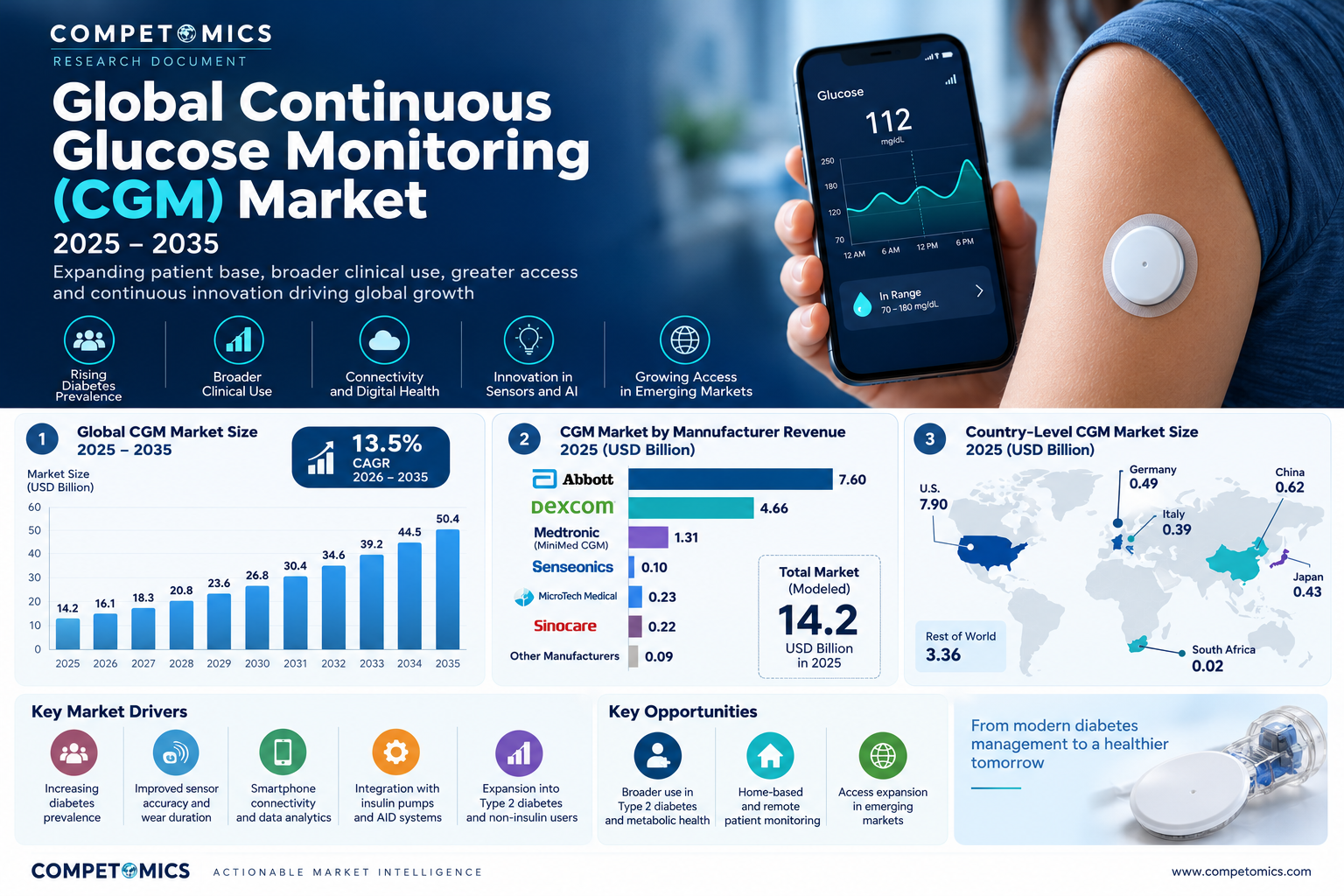
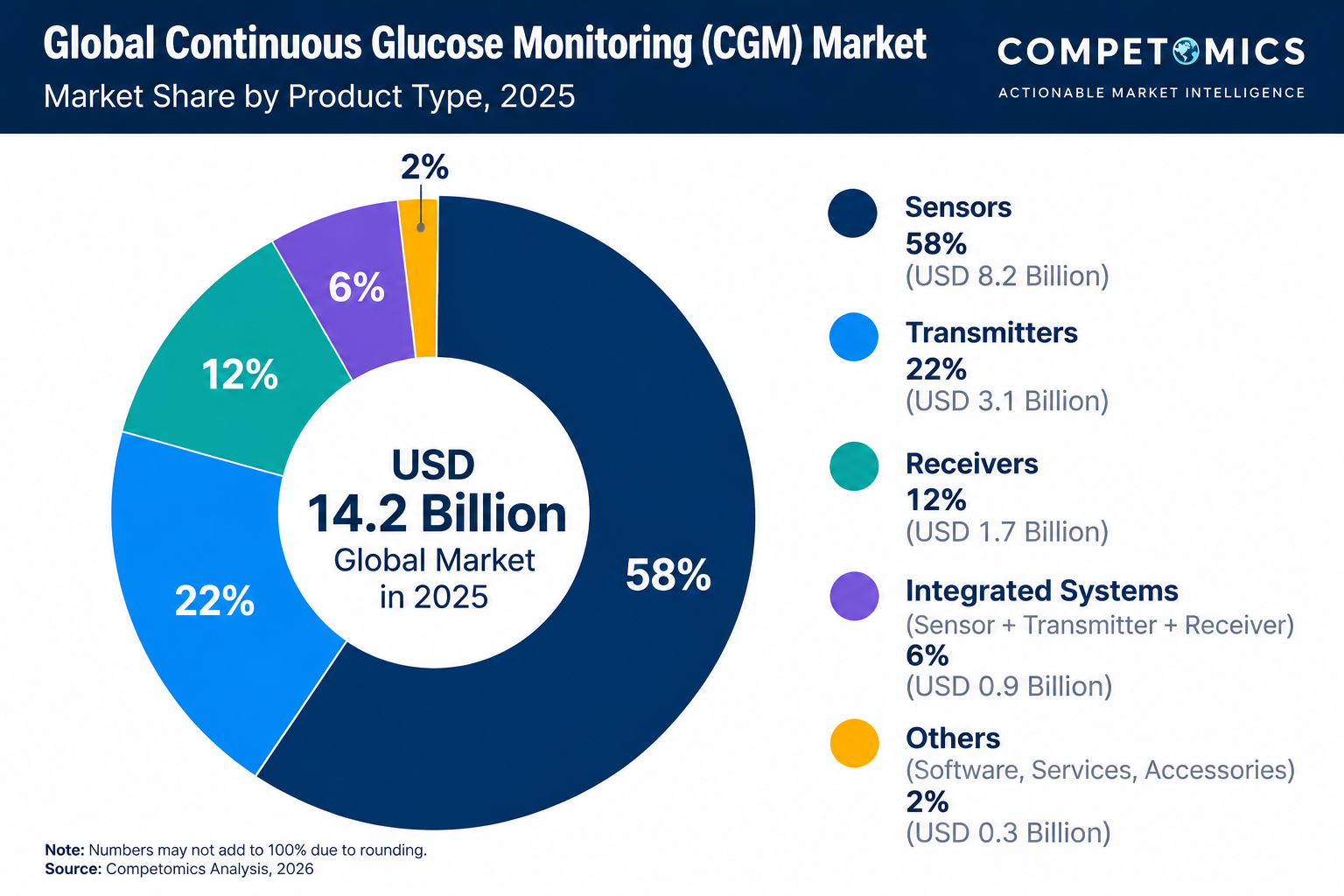
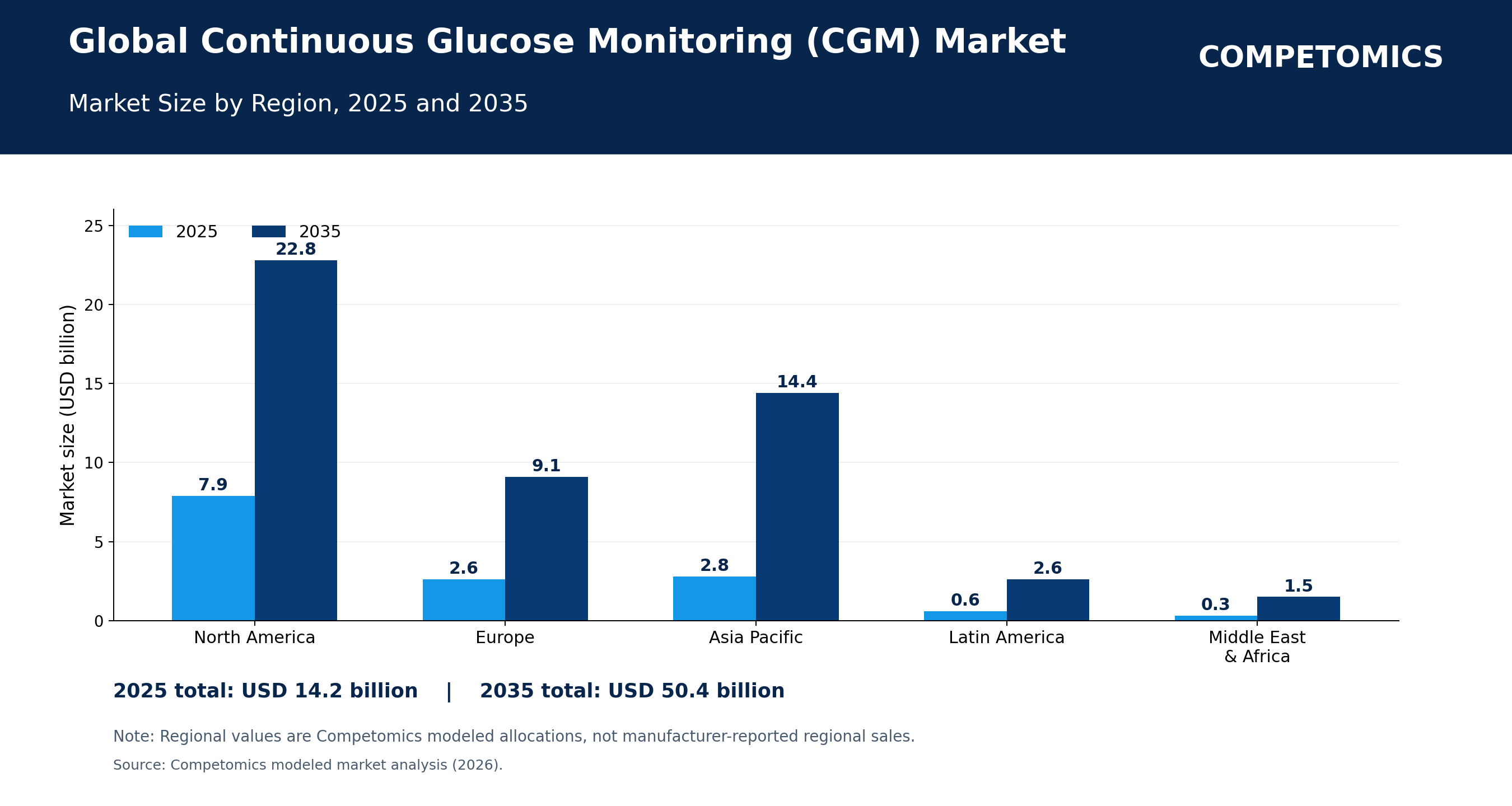
The global continuous glucose monitoring (CGM) market is estimated at USD 14.2 billion in 2025 and is projected to reach approximately USD 50.4 billion by 2035, representing a modeled 13.5% CAGR during 2026-2035. The estimate is anchored to reported 2025 manufacturer revenues and adjusted for fiscal-year differences, non-CGM product sales, and incompletely disclosed competitors. Growth is supported by broader CGM use among insulin-treated and non-insulin-treated people with diabetes, sensor accuracy and wear-duration improvements, integration with automated insulin delivery, digital care pathways, and increasing reimbursement access. The headline market size and forecast are Competomics estimates, not audited industry totals.
MARKET VISUALS
Market Overview & Sample Analysis
The transition from episodic self-monitoring of blood glucose (SMBG) to continuous, connected glucose data is reshaping diabetes management. CGM adoption is accelerating as clinicians increasingly value time-in-range, glucose variability, and actionable alerts alongside HbA1c. Sensor access is expanding beyond intensive insulin users, although clinical eligibility, reimbursement, and affordability differ substantially between countries. Manufacturers are competing on total cost of use, sensor wear duration, calibration burden, analytical accuracy, ease of insertion, software ecosystems, and integration with insulin pumps. Longer sensor lifetimes can improve convenience but also alter annual sensor units and average selling prices; consequently, market forecasts should not simply multiply patient growth by current sensor utilization. Market expansion also depends on reimbursement policy, clinician adoption, and distribution. Pharmacy access and remote monitoring may improve access, while procurement tenders and payer pressure can reduce realized manufacturer revenue per patient. The net effect is expected to favor volume growth with differentiated pricing by geography and product tier.
MARKET VISUALS
Market Overview & Sample Analysis
Segmentation analysis - By Component Sensors and associated disposable consumables represent the largest recurring revenue pool in the CGM value chain in the 2025 base year, reflecting repeated replacement cycles, established distribution networks, and the expanding installed user base. The exact global component share is not separately disclosed across manufacturers and is therefore not asserted as a verified percentage. Growth depends on wear duration, sensor utilization per patient, retention, and reimbursement. Improvements in reliability, form factor, and manufacturing yield may lower costs while supporting broader access. Transmitters, readers, and dedicated receiver devices account for a smaller and structurally evolving revenue opportunity. Integrated and smartphone-enabled designs can reduce reliance on standalone receivers, while selected clinical settings and user populations still require dedicated displays. Software, analytics, and connected services are strategically important and may be among the fastest-evolving components, but revenue attribution is inconsistent: many manufacturers bundle digital features into hardware prices rather than report them as standalone CGM sales. The report therefore treats the sensor-led recurring model as dominant and digital capabilities as a principal growth enabler, without inventing a separate software revenue share. Segmentation analysis — By Product Type Real-time CGM systems are expected to account for the largest share of 2025 manufacturer revenue, supported by continuous readings, predictive alerts, integration with automated insulin delivery, and broad adoption among insulin-treated users. Their clinical utility in hypoglycemia prevention and treatment adjustment supports continued use across Type 1 diabetes and insulin-intensive Type 2 diabetes. Competitive differentiation is increasingly based on accuracy, wear duration, interoperability, and total cost per year. Intermittently scanned or flash monitoring solutions remain important in price-sensitive channels and established reimbursement pathways. Product boundaries are becoming less rigid as manufacturers introduce real-time features across product families. Implantable CGM constitutes a smaller specialized segment with differentiated sensor longevity and insertion workflows. Faster growth may occur in selected implantable and lower-cost product niches from a small base, but reliable worldwide product-type revenue shares are not disclosed consistently enough to publish precise rankings beyond the real-time category’s expected leadership. Segmentation analysis — By Patient Type Type 1 diabetes is a mature, high-intensity CGM application because insulin dose adjustment, hypoglycemia avoidance, and pump integration benefit directly from continuous data. The installed base and high frequency of use support significant revenue per patient. Nevertheless, Type 2 diabetes is expected to be the larger incremental growth opportunity in absolute user numbers as coverage expands among people using multiple daily insulin injections, basal insulin, and, in some markets, selected non-insulin regimens. Gestational diabetes and other specialist applications create targeted opportunities, but use is influenced by clinical guidelines and payer eligibility. The fastest-growing patient category is expected to be selected Type 2 subgroups in markets where reimbursement broadens, although the forecast should distinguish covered clinical use from general wellness products. Competomics does not assume that every person with diabetes will become a continuous year-round CGM user. Segmentation analysis — By End User and Channel Home and self-management use represents the largest end-use setting because CGM is primarily worn in daily life and interpreted through smartphones, receivers, and connected care platforms. Hospital and outpatient clinics remain central to initiation, education, and treatment optimization, while professional or episodic CGM programs serve targeted diagnostic and therapeutic purposes. Pharmacies and reimbursed distribution networks represent major channels in established markets, with direct-to-consumer and e-commerce models becoming more visible where regulations permit. Remote-care platforms and digital therapeutics can expand engagement, but payer policies and local distribution margins complicate comparisons between manufacturer revenue and retail spending. The forecast uses manufacturer net revenue and excludes downstream markups to avoid inflating the global total.
MARKET VISUALS
Market Overview & Sample Analysis
Regional analysis North America is the largest CGM revenue region in the 2025 model, led by the United States. The U.S. benefits from substantial manufacturer sales, established reimbursement pathways, broad clinical awareness, and extensive pharmacy distribution. However, the existing Competomics U.S. market estimate of USD 7.90 billion remains a working geographic allocation and is not directly audited from all suppliers’ U.S. CGM-only sales. Europe is a mature but heterogeneous market. Germany, Italy, France, the United Kingdom, and Nordic countries differ in coverage, prescribing criteria, and procurement models. Germany and Italy have established CGM use, but individual country values require manufacturer-geography allocation checks rather than extrapolation from population alone. Europe is expected to grow steadily through wider Type 2 eligibility and device upgrades. Asia Pacific is expected to offer one of the strongest long-term expansion opportunities because of its large diabetes population, improving access, and emerging domestic manufacturing. China combines local manufacturers and international competitors, while Japan emphasizes regulated clinical use and reimbursement pathways. Price competition and country-specific access rules mean unit growth may exceed revenue growth. Latin America remains earlier in CGM penetration in many countries, constrained by out-of-pocket affordability and uneven public reimbursement. Brazil and Mexico offer scale, while private-care channels and lower-cost sensors may broaden access. Middle East and Africa are also heterogeneous: higher-income Gulf markets offer connected-care adoption opportunities, while affordability and health-system capacity constrain many African markets. South Africa is a useful country case but does not represent the wider region.
MARKET VISUALS
Market Overview & Sample Analysis
Competitive landscape
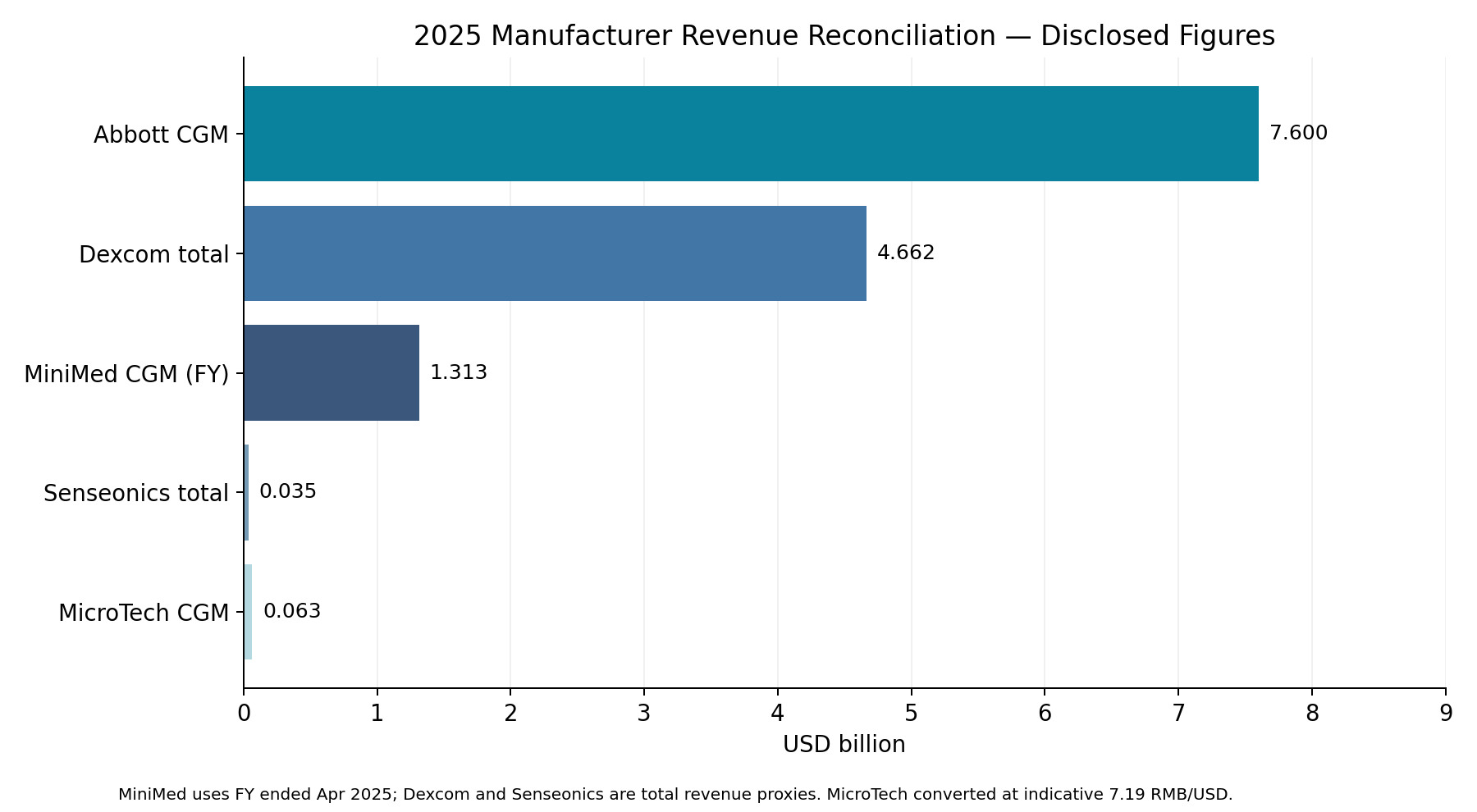
Abbott and Dexcom anchor the global competitive landscape. Abbott reported USD 7.6 billion in 2025 CGM sales, and Dexcom reported USD 4.662 billion in total 2025 company revenue. MiniMed separately disclosed USD 1.313 billion in CGM sales for the fiscal year ended April 25, 2025. These three groups therefore represent the largest disclosed CGM-related revenue pools in the present reconciliation, although fiscal periods and revenue definitions are not perfectly aligned. Abbott benefits from FreeStyle Libre scale, broad international reach, and manufacturing capacity. Dexcom competes through its sensor portfolio, digital ecosystem, and strong U.S. presence. MiniMed combines CGM technology with automated insulin delivery and an established installed base. Senseonics differentiates through long-duration implantable technology, while MicroTech Medical and other Chinese suppliers are increasing competition in lower-cost and domestic channels. Commercialization partnerships, product introductions, interoperability improvements, and geographic expansion are the most relevant competitive developments; individual transactions should be dated and verified before inclusion in a current-news section. For market sizing, Abbott CGM and MiniMed CGM are category-specific disclosures; Dexcom and Senseonics company revenue are used as approximate CGM proxies; MicroTech CGMS revenue is separately disclosed in renminbi. The difference between the disclosed/proxy subtotal and Competomics USD 14.2 billion modeled total is allocated to remaining manufacturers and fiscal-calendar adjustments. This residual is a modeling assumption, not an audited line item.